Miguel Caballero
AT&T Research Fellow; Associate Professor
PhD, Princeton University
- miguel.caballero@northwestern.edu
- 847-491-8136
- 3-129 Crowe
Miguel Caballero is Associate Professor of Iberian Studies with a transatlantic perspective, specializing in the 20th and 21st centuries. His methodological approach connects literature, art, philosophy, and science.
Two main areas of research interests:
1. Medical humanities, specifically HIV/AIDS studies. He is currently working on a book tentatively titled Adherence and Addiction: Queer Attachments and the "End of AIDS", exploring HIV art, literature, and critical theory from the development of effective antiretroviral medications for treatment and prevention (1996–) through the United Nations' goal of “ending AIDS as a public health threat by 2030.” This academic project builds on activist work, with writings published in ASS (Amor, Sexo y Serología), and cuadernoVIH, as well as on fieldwork conducted in molecular pathology laboratories, biotechnology conferences, and pharmaceutical companies.
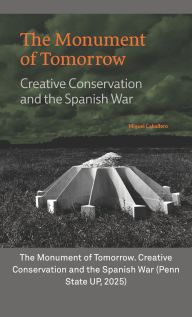
2. Historical avant-gardes, modernism, and anti-fascism. His book, The Monument of Tomorrow: CreativeConservation and the Spanish War (Penn State University Press, 2025), examines how the radical theory and practice of creative destruction evolved into creative conservation in response to the rise of fascism in the 1920s and 1930s. In wartime Spain, writers, artists, architects, philosophers, activists, and the people at large pioneered avant-garde approaches to conservation and radical monumentality. This position laid the groundwork for later protectionist efforts during World War II and contributed to the development of the concept of World Heritage.
The Monument of Tomorrow was a finalist for the 2026 Charles Rufus Morey Book Award from the College Art Association (CAA) and received an Honorable Mention for the 2026 Elizabeth Tufts Award from the Society for Iberian Global Art.
In connection with this research, he has curated two exhibitions: Ephemeral Treasures in Moscow (sponsored by the Neubauer Collegium of Culture and Society) and the solo exhibition of artist Fernando Sánchez Castillo Fake Games. The Collectivized Monument in IVAM, Valencia.
Caballero’s work is rooted in archival research and adopts a transnational perspective. He has published on Spanish communist monumentality in the Soviet Union in Journal of Spanish Cultural Studies; wartime scale-models of the destruction produced by air raids also in Journal of Spanish Cultural Studies; the ideology of labor in modern architecture in Brazi with Revista Hispánica Moderna; agitation trains in Lázaro Cárdenas’s Mexico, forthcoming with Hispanic Review; or the Museum of Memory and Human Rights in Chile, in Revista Canadiense de Estudios Hispánicos, among others. He has contributed to monographs on collective art (CSIC), modern architecture in Cuba (Arquine), environmental cultural studies (Tamesis), and new realisms (Almenara).
He is also interested in psychoanalysis, organized the conference “Freud Today” at the Freud Museum in Vienna, and was a Fellow of the American Psychoanalytic Association.
He is part of the working group “Puentes creativos. Desplazamientos, retornos, disidencias y adhesiones en el arte español contemporáneo” at Consejo Superior de Investigaciones Científicas in Spain.
At Northwestern, in addition to his primary appointment in the Department of Spanish and Portuguese, he is Director of the Cluster in Global Avant-Garde and Modernism and Director of Undergraduate Engagement at the Kaplan Institute for the Humanities. He is also affiliated with the Cluster in Critical Theory, the Department of Art History, and the Program in Comparative Literary Studies.
Caballero welcomes inquiries to advise undergraduate and graduate projects on the historical and neo-avant-gardes, heritage studies, medical humanities, HIV/AIDS studies, queer studies, or other topics related to 20th and 21st century culture at the intersections of literature, art, and philosophy.